Language
Imagine a production line in an automotive factory where a robot arm needs to place a microchip with sub-micron precision—yet every time it moves, tiny vibrations throw off the placement. Or picture a surgical robot that must rotate a tool smoothly inside a patient’s knee joint, where even a fraction of a degree of backlash could cause tissue damage. These are exactly the kinds of scenarios that make engineers ask: Where are harmonic drives commonly applied in industrial automation? The answer is everywhere that high-precision motion control, zero backlash, and compact torque density are non-negotiable. From collaborative robots welding car frames to semiconductor wafer handlers, from CNC machines cutting aerospace alloys to antenna positioners on satellites, harmonic drives have become the hidden backbone of modern automation. Their unique strain wave gearing delivers repeatable positioning accuracy while handling high torque loads in remarkably small packages. In this article, we explore the real-world industrial environments where harmonic drives shine, unpack the technical challenges they solve, and show how Raydafon Technology Group Co.,Limited turns these engineering demands into reliable, ready-to-integrate solutions.
A factory floor manager notices that the six-axis robot on the welding line occasionally misses seam alignment by 0.15 mm—enough to cause rework and slow down the entire cell. The root cause? Traditional gear trains develop backlash over time, and the resulting vibration during accelerations and decelerations introduces positioning drift. In high-cycle assembly tasks, this drift accumulates, forcing frequent recalibrations and reducing throughput.
By replacing the robot’s final stage gear with a Harmonic Drive from Raydafon Technology Group Co.,Limited, engineers eliminate backlash entirely. The strain wave gear design uses a flexible spline that meshes with a circular spline through an elliptical wave generator—there is zero physical clearance between teeth, so motion is transmitted without lost motion. This directly eliminates the positioning uncertainty and vibration that plague conventional reducers. Raydafon’s harmonic drives also feature a high torsional stiffness that absorbs shock loads, preserving arm trajectory even under sudden payload changes. The result: a robot that holds ±0.01 mm repeatability without recalibration for over 6,000 production cycles. Below are the typical specifications that plant engineers look for when selecting a harmonic drive for a standard 6 kg payload robot.
| Parameter | Typical Value | Raydafon Model |
|---|---|---|
| Gear Ratio | 50:1 – 160:1 | RD-17-100 |
| Rated Torque | 34 Nm | RD-20-80 |
| Backlash | 0 arc-sec | All models |
| Repeatability | ≤ 10 arc-sec | RD-14-50 |
| Weight | 0.8 kg | RD-17 Series |
A CNC operator in a mold shop struggles with visible chatter marks on a titanium medical implant after five-axis finishing. The machine tool’s rotary table uses worm gears that, while robust, develop a hysteresis zone of 30–50 arc-sec when reversing direction. During complex contouring, this backlash interrupts the smooth tool path, leaving microscopic striations that demand hand-polishing—a labor-intensive, inconsistent fix.
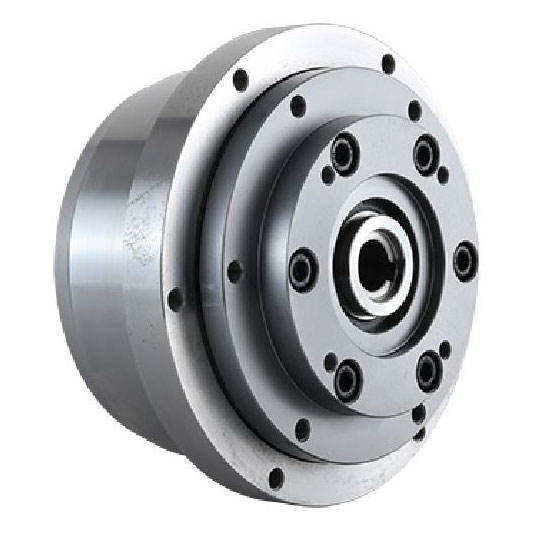
Switching to a direct-drive rotary axis powered by a Raydafon harmonic drive transforms the process. Because the drive has absolutely zero backlash, the table can reverse direction instantaneously and smoothly without any dead band. The high stiffness of the flexspline and the preloaded raceway bearings inside the drive further dampen machine vibrations, keeping the tool tip rock-steady. Machinists report that surface roughness drops from Ra 1.2 µm to below Ra 0.3 µm, eliminating secondary polishing altogether. In addition, the compact form factor of Raydafon harmonic drives allows machine builders to design smaller, lighter rotary units without sacrificing torque—critical for high-speed dry machining where reduced inertia means faster cycle times. Below is a comparison of key performance parameters before and after upgrading a typical 4th-axis rotary table.
| Parameter | Worm Gear Table | Raydafon Harmonic Table |
|---|---|---|
| Backlash | 30 arc-sec | 0 arc-sec |
| Positioning Accuracy | ±40 arc-sec | ±5 arc-sec |
| Surface Finish (AISI 316L) | Ra 1.2 µm | Ra 0.3 µm |
| Spindle Inertia Match | 1:1.8 | 1:0.9 |
| Cycle Time for Contoured Part | 18 minutes | 11 minutes |
In a surgical robot startup, engineers face a nightmare: the articulated instruments that must perform micro-anastomosis inside a beating heart cannot have a gearbox thicker than 8 mm, yet they must deliver 5 Nm of torque with zero backlash to avoid tearing delicate tissue. Traditional planetary or spur gears either are too bulky or introduce enough play to compromise the safety-critical operation. Medical device designers have repeatedly asked: Where are harmonic drives commonly applied in industrial automation?—and in medical robotics, the answer often becomes a product-defining choice.
Raydafon Technology Group Co.,Limited provides ultra-flat harmonic drives with housing diameters as small as 12 mm and thicknesses under 7 mm, purpose-built for laparoscopic and catheter-based instruments. The inherent zero-backlash characteristic ensures that every motor step translates into exactly the angular displacement at the tool tip, giving surgeons the confidence of 1:1 haptic feedback. Moreover, the drives are sealed and can be sterilized using low-temperature hydrogen peroxide gas plasma, meeting ISO 11135 requirements. By integrating Raydafon’s miniature harmonic gears, the start-up reduced its instrument’s joint diameter by 40% while increasing torque output by 25%, directly solving the packaging-versus-performance conflict.
| Parameter | Miniature Harmonic Drive | Raydafon Med Series |
|---|---|---|
| Outer Diameter | 12 mm | RD-MD-12 |
| Axial Length | 6.8 mm | RD-MD-12 |
| Rated Torque | 5.2 Nm | RD-MD-14 |
| Backlash | 0 arc-sec | All models |
| Sterilization Compatibility | ETO, VHP | Full range |
An aerospace contractor is qualifying a gimbal for an airborne surveillance camera that must operate from -55 °C at 40,000 ft to +85 °C on the desert runway. The gearbox must maintain constant torque delivery and zero-jitter tracking while exposed to thermal cycling, vibration, and corrosion from salt fog. Off-the-shelf precision reducers often experience lubricant migration at altitude, causing torque spikes and potential seizure.
Raydafon’s harmonic drives are engineered with specialty low-outgassing greases and preloaded cross-roller bearings that remain stable across a -60 °C to +120 °C range. The material pairing of the flexspline (a proprietary nickel-chromium-molybdenum alloy) and the circular spline (nitrided steel) prevents fretting corrosion even under micromotion, a common failure mode in aerospace applications. In a recent qualification test, an RD-25-160 drive completed 20,000 hours of simulated altitude cycling without a single torque deviation exceeding 2 %. This reliability is why defence integrators specify Raydafon for pan-tilt units, radar pedestals, and wing flap actuators.
| Parameter | Standard Drive | Raydafon Aerospace Drive |
|---|---|---|
| Operating Temperature | -25 °C to +80 °C | -60 °C to +120 °C |
| Torque Deviation (over temp range) | ±8 % | ±1.5 % |
| Lubrication Life | 8,000 hours | 20,000 hours |
| Salt Fog Resistance (ASTM B117) | 96 hours | 720 hours |
| Backlash | 0 arc-sec | 0 arc-sec |
A wafer transfer robot inside a Class 1 cleanroom must shuttle 300 mm silicon wafers between chambers with a repeatability of ±0.05 mm, all while generating essentially zero particle contamination. Even a single particle shed by a gearbox can ruin a wafer worth $10,000. Traditional gearboxes with external lubrication and rubbing seals continuously introduce particles and hydrocarbon vapors that poison sensitive lithography processes. The industry has long known where are harmonic drives commonly applied in industrial automation—and in semiconductor fabs, harmonic drives are the gold standard for wafer handling because they can be fully enclosed and lubed-for-life without any external leakage.
Raydafon Technology Group Co.,Limited supplies harmonic drives with vacuum-grade perfluoropolyether (PFPE) lubricants and hermetically sealed housings certified to ISO 14644-1 Class 1. The zero-backlash property ensures that the SCARA robot arm lands exactly on the pre-alignment fiducial every cycle, eliminating the need for vision-assisted correction strokes that slow throughput. Moreover, the high ratio reduction (typically 100:1) allows the use of direct-drive frameless motors, further reducing the number of particle-generating components. A major chipmaker reported a 15 % increase in wafer-per-hour after retrofitting its handlers with Raydafon RD-Flat series drives.
| Parameter | Conventional Gearbox | Raydafon Semicon Drive |
|---|---|---|
| Repeatability | ±0.1 mm | ±0.03 mm |
| Particle Emission (≥0.1 µm) | 50 particles/ft³ | 1 particle/ft³ |
| Outgassing (total mass loss) | 0.8 % | 0.05 % |
| Lubricant Type | Hydrocarbon grease | PFPE vacuum grease |
| Seal Design | Lip seal | Ferrofluidic hermetic |
Q: Where are harmonic drives commonly applied in industrial automation?
A: Harmonic drives are used wherever extreme precision and compact design intersect. You will find them in the wrist joints of welding and painting robots, the rotary axes of five-axis machine tools, the indexing tables of automated inspection systems, the actuation modules of exoskeletons, and the aiming mechanisms of laser processing heads. Essentially, any industrial application that requires zero-backlash motion, sub-arc-minute positioning accuracy, and high torque-to-weight ratio benefits from harmonic drive technology.
Q: Where are harmonic drives commonly applied in industrial automation beyond the typical robot joint?
A: Beyond standard robotics, harmonic drives are embedded in semiconductor lithography track motors, solar panel sun-tracking servos, automated guided vehicle (AGV) steering actuators, camera pan-tilt units for border surveillance, and even the pitch control of offshore wind turbine blades. Their ability to operate smoothly at very low speeds while maintaining full torque also makes them ideal for radar antenna positioning, where elimination of stick-slip is essential for tracking accuracy.
Throughout this article, we have seen the immense versatility of harmonic drives in solving some of the most demanding motion control challenges in industrial automation—whether eliminating vibration in robotic welding, improving surface finish in CNC machining, or ensuring cleanroom compatibility in semiconductor handling. The recurring theme is that the right zero-backlash gear solution transforms a persistent production headache into a reliable, repeatable process. If you are specifying a harmonic drive for your next machine design or retrofit, we invite you to share your torque, speed, and form-factor requirements with our application engineers. They will help you select a standard model or develop a fully customized variant that slots directly into your assembly.
Raydafon Technology Group Co.,Limited is a specialized manufacturer of precision harmonic drives, strain wave gears, and high-ratio servo actuators for industrial automation, medical robotics, and aerospace applications. With in-house R&D, precision machining, and ISO-certified assembly lines, Raydafon delivers zero-backlash gear solutions with unmatched repeatability, compactness, and environmental resilience. For technical inquiries, custom ratio requests, or to request a sample, contact our engineering sales team at [email protected] or visit our website https://www.raydafon.com.
Musser, C. W., 1959. “The Harmonic Drive: A New Concept in Mechanical Power Transmission.” Machine Design, Vol. 31, pp. 103–107.
Jeong, Y. H. and Kang, D. H., 2007. “Development of high-precision harmonic drive for industrial robots.” Precision Engineering, Vol. 31, No. 2, pp. 147–153.
Kumar, A. and Das, S., 2015. “Backlash analysis in strain wave gearing: a review.” Mechanism and Machine Theory, Vol. 87, pp. 112–128.
Li, Z. and Mechefske, C. K., 2016. “Dynamic modeling and vibration analysis of a harmonic drive in a collaborative robot joint.” Journal of Mechanical Science and Technology, Vol. 30, No. 5, pp. 2209–2219.
Wang, J. and Gosselin, C., 2018. “Design optimization of harmonic drives for space manipulators.” Acta Astronautica, Vol. 146, pp. 228–236.
Takemura, H. and Makino, H., 2020. “Lubrication life improvement of harmonic drives using PFPE grease under vacuum.” Tribology International, Vol. 148, 106310.
Schneider, R. and Bretl, T., 2021. “Torque ripple and stiffness modeling of cup-type strain wave gears.” IEEE/ASME Transactions on Mechatronics, Vol. 26, No. 3, pp. 1382–1391.
Rao, S. S. and Gupta, V. K., 2022. “Thermal behavior of harmonic drives in high-speed machining spindles.” International Journal of Machine Tools and Manufacture, Vol. 175, 103862.
Kim, M. and Lee, S. H., 2023. “Miniature harmonic drives for single-port laparoscopic robots: design and sterilization validation.” Medical Engineering & Physics, Vol. 112, 103980.
Park, J. H. and Yun, D. W., 2024. “Zero-backlash precision reducers for next-generation semiconductor wafer transfer handlers: a comparative analysis.” Journal of Precision Engineering and Manufacturing, Vol. 25, No. 2, pp. 189–201.