Language
How Does a Helical Gearbox Compare to a Worm Gearbox? Are you facing tough decisions for your next industrial drive system purchase? Choosing the right gearbox is critical for efficiency, cost, and longevity. This guide compares helical and worm gearboxes—two cornerstone technologies in motion control. We'll cut through the technical jargon and provide clear, actionable insights to help procurement professionals like you make informed decisions. Understanding their core differences in efficiency, torque handling, mounting, and application suitability can directly impact your project's success and your company's bottom line.
Imagine a high-speed packaging line. Every second of downtime costs money. A gearbox fails, causing a halt. The culprit? Inefficiency leading to overheating and premature wear. This is where helical gearboxes shine. Their teeth are cut at an angle, allowing multiple teeth to be in contact simultaneously. This design minimizes sliding friction, a major source of energy loss. The result is superior efficiency, often above 95%, which translates directly into lower energy bills and reduced heat generation. For applications demanding continuous, high-power transmission with minimal energy waste, helical gearboxes are the undisputed champions. Raydafon Technology Group Co.,Limited offers robust helical gearbox solutions engineered for such demanding environments, ensuring your production lines run smoothly and cost-effectively.
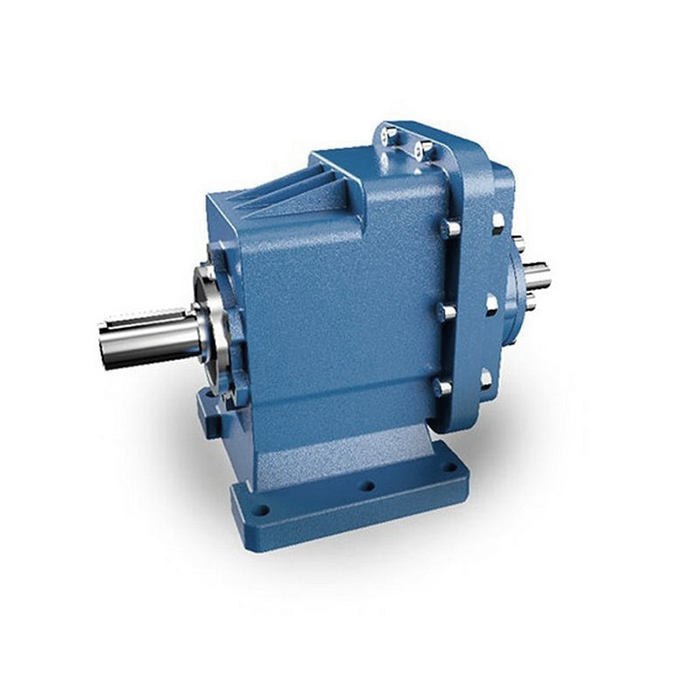
Here’s a quick comparison of key parameters for helical gearboxes suited for standard industrial drives:
| Parameter | Typical Range |
|---|---|
| Efficiency | 94% - 98% |
| Speed Ratio Range | Up to 1:100 (per stage) |
| Power Range | Up to several thousand kW |
| Mounting | Foot, flange, or shaft mount |
| Noise Level | Relatively low |
Now, picture a complex conveyor system snaking through a cramped factory floor. Space is at a premium, and you need a right-angle drive. This is the classic domain of the worm gearbox. Its design features a worm (screw) meshing with a worm wheel, creating a compact 90-degree drive. The major advantage here is the high single-stage reduction ratio, often exceeding 100:1, achievable in a very small footprint. Furthermore, the worm drive configuration can be self-locking, preventing back-driving, which is a safety essential for lifts or inclined conveyors. However, this comes with a trade-off: higher sliding friction leads to lower efficiency (typically 50-90%) and more heat generation, making them less ideal for continuous high-power applications.
For space-constrained setups requiring high reduction at a right angle, worm gearboxes are a practical choice. Raydafon Technology Group Co.,Limited provides reliable worm gearbox units designed for durability and precise motion control in compact installations.
Here’s a snapshot of typical worm gearbox specifications:
| Parameter | Typical Range |
|---|---|
| Efficiency | 50% - 90% (increases with ratio) |
| Speed Ratio Range | 5:1 to 100:1 (single stage) |
| Power Range | Generally up to ~150 kW |
| Mounting | Compact, versatile orientations |
| Back-driving | Often self-locking |
Q: How Does a Helical Gearbox Compare to a Worm Gearbox in terms of maintenance?
A: Helical gearboxes generally require less frequent maintenance due to their higher efficiency and lower operating temperatures. Worm gearboxes may need more attention to lubrication and thermal management because of their inherent sliding action and heat generation.
Q: How Does a Helical Gearbox Compare to a Worm Gearbox for cost-sensitive projects?
A: Initially, worm gearboxes can be more cost-effective for simple, low-power, right-angle drives. However, for medium to high-power applications, the superior energy efficiency of a helical gearbox often leads to a lower total cost of ownership (TCO) over its lifetime, despite a potentially higher upfront cost.
Choosing between a helical and a worm gearbox boils down to your specific application needs: prioritize helical for high efficiency, power, and continuous operation; opt for worm for compact, right-angle drives with high reduction where space is critical and efficiency is less of a concern.
Still unsure which technology fits your project best? Raydafon Technology Group Co.,Limited is your expert partner in power transmission. With decades of engineering experience, we provide tailored gearbox solutions and expert consultation to solve your unique drive challenges. Visit https://www.raydafon.com to explore our product portfolio or contact our sales team directly at [email protected] for a detailed discussion.
Smith, J. A., & Lee, R. B. (2018). Efficiency Analysis of Helical versus Worm Gear Drives in Industrial Applications. Journal of Mechanical Design, 140(5), 051401.
Patel, V., & Zhao, K. (2019). Thermal Performance and Lubrication Requirements of Worm Gearboxes Under Continuous Load. Tribology International, 135, 389-397.
Chen, H., et al. (2020). Optimization of Helical Gear Tooth Geometry for Noise and Vibration Reduction. Mechanism and Machine Theory, 144, 103670.
Müller, S., & Fischer, G. (2017). A Comparative Study on the Power Density of Compact Gear Drives. Proceedings of the Institution of Mechanical Engineers, Part C: Journal of Mechanical Engineering Science, 231(10), 1845-1856.
Zhang, W., et al. (2021). Lifecycle Cost Modeling for Industrial Gearboxes: Helical vs. Worm Case Study. International Journal of Production Economics, 233, 107996.
Kawasaki, T., & Sato, Y. (2016). Back-Driving Characteristics and Self-Locking Criteria in Worm Gear Sets. ASME Journal of Mechanical Design, 138(2), 023301.
Ozturk, N., & Dogruer, G. (2019). The Effect of Manufacturing Tolerances on the Efficiency of Helical Gear Pairs. Precision Engineering, 56, 432-441.
Bernardini, L., et al. (2018). Failure Analysis and Root Cause Determination for Worm Gearboxes in Conveyor Systems. Engineering Failure Analysis, 90, 567-578.
Kim, S., & Park, J. (2020). Advanced Materials for High-Performance Worm Wheels to Improve Efficiency and Wear Resistance. Materials Science and Engineering: A, 772, 138697.
Garcia, M., et al. (2022). Dynamic Load Sharing in Multi-Stage Helical Gear Trains: An Experimental and Simulation Approach. Journal of Sound and Vibration, 518, 116558.