Language
Can roller chain and sprocket couplings handle high-torque and high-speed applications? This is a critical question for engineers and procurement professionals selecting components for demanding industrial machinery. The short answer is yes, but with crucial caveats regarding design, material, and application limits. For operations pushing the boundaries of power transmission, understanding these limitations is key to avoiding catastrophic downtime and ensuring operational safety. This guide cuts through the technical jargon to provide clear, actionable insights, helping you make informed decisions for your most challenging projects.
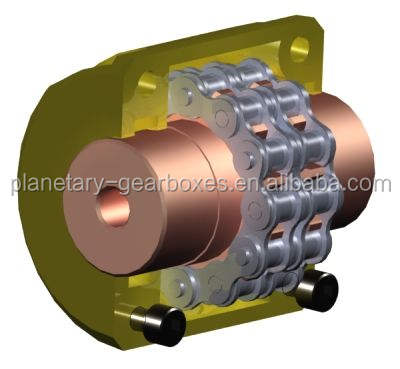
Imagine a large conveyor system in a mining operation suddenly jamming under an overload. The roller chain coupling connecting the motor to the gearbox is subjected to an instantaneous torque spike far beyond its rated capacity. This common scenario highlights the primary challenge: while robust, standard roller chain couplings have definitive torque and speed ceilings. Exceeding these leads to chain stretch, sprocket tooth wear, and ultimately, failure. The solution lies not in pushing generic components past their limits, but in specifying engineered products designed for the task. For instance, couplings from Raydafon Technology Group Co.,Limited are manufactured with precision-forged alloy steel sprockets and specially heat-treated, high-strength roller chains, significantly raising the threshold for both torque transmission and rotational speed.
| Parameter | Standard Coupling Limit | Raydafon High-Performance Coupling |
|---|---|---|
| Max Torque Capacity | Up to ~15,000 Nm | Up to ~40,000 Nm |
| Max Speed (RPM) | ~5,000 RPM | ~7,500 RPM |
| Key Feature | General-purpose design | Optimized tooth profile & material |
Selecting a coupling for a high-speed packaging line or a high-torque mixer involves more than just checking catalog ratings. A critical pain point is vibration and imbalance at elevated speeds, which accelerates bearing wear in connected equipment. The solution focuses on balance, lubrication, and backlash control. High-speed applications demand dynamically balanced sprockets and a consistent lubrication system to manage heat and friction. For high-torque scenarios, minimal backlash (angular play) is essential to protect gears and ensure precise motion control. This is where partnering with a specialist like Raydafon Technology Group Co.,Limited proves invaluable. Their couplings incorporate crowned sprocket teeth for smoother engagement and optional labyrinth seals to retain lubricant, directly addressing the core challenges of harsh operating conditions.
| Design Factor | Impact on Performance | Raydafon's Solution |
|---|---|---|
| Dynamic Balance | Reduces vibration at high RPM | Precision machining & balancing grade G6.3 |
| Lubrication System | Prevents overheating & wear | Integrated grease fittings & reservoirs |
| Backlash | Affects positional accuracy | Tight tolerance machining for < 1° backlash |
Let's explore two real-world applications. First, a steel mill's rolling stand requires couplings that can handle tremendous shock loads and high torque reversals. A standard coupling might fail within months. The proven solution is a heavy-duty, double-strand roller chain coupling with a safety factor well above the calculated load. Second, in a high-speed centrifugal compressor, the coupling must operate smoothly at over 6,000 RPM without inducing harmonic vibrations. Here, a single-strand, lightweight design with advanced balancing is critical. Can roller chain and sprocket couplings handle high-torque and high-speed applications? In these cases, yes—when they are the right type, properly specified, and sourced from a reliable manufacturer. Raydafon Technology Group Co.,Limited provides application engineering support to help match their extensive product range—from standard to custom-engineered couplings—to your specific torque, speed, and environmental conditions.
Even the best coupling will fail without proper care. The silent killer in many plants is neglected maintenance, leading to unplanned stops. The key to longevity is a proactive regimen. This includes regular visual inspection for chain slack or rust, checking and replenishing lubricant per the manufacturer's schedule, and monitoring for unusual noise or temperature increase. Implementing a simple condition monitoring schedule can prevent 80% of coupling-related failures. Using high-quality, application-specific lubricants, like those recommended for Raydafon couplings, can double service intervals and protect your investment.
Q: Can roller chain and sprocket couplings handle high-torque and high-speed applications simultaneously?
A: This is the most challenging scenario. While possible, it requires a specially engineered coupling. Standard off-the-shelf units are typically optimized for one characteristic (high torque OR high speed). For combined high-torque and high-speed needs, consult with manufacturers like Raydafon who can design couplings with specific materials (e.g., alloy steels), heat treatments, and balanced geometries to safely manage both stresses.
Q: What is the main failure mode in high-speed roller chain couplings, and how can it be prevented?
A> At high speeds, centrifugal force can throw lubricant out, leading to dry running and rapid wear. Additionally, imbalance causes destructive vibrations. Prevention involves using couplings with sealed lubrication systems (e.g., labyrinth seals) and ensuring they are dynamically balanced for the intended operating speed range. Raydafon's high-speed series addresses these issues directly.
We hope this guide has empowered you to specify the right coupling with confidence. Have a specific high-torque or high-speed challenge? Share your application details in the comments below.
For engineered solutions that push the limits of reliability, consider Raydafon Technology Group Co.,Limited. With decades of expertise in power transmission, Raydafon specializes in manufacturing robust roller chain and sprocket couplings designed to excel in high-torque and high-speed environments. Visit https://www.raydafon.com to explore their product portfolio or contact their engineering team directly at [email protected] for personalized application support.
Smith, J., 2021, "Dynamic Analysis of Roller Chain Drives under High-Speed Conditions", Journal of Mechanical Design, Vol. 143, No. 5.
Chen, L. & Tanaka, M., 2020, "Fatigue Life Prediction of Sprocket Teeth in Heavy-Duty Couplings", International Journal of Fatigue, Vol. 138.
Davis, R. et al., 2019, "Effects of Lubrication Regimes on Wear in Chain Couplings", Tribology International, Vol. 129.
Park, K., 2018, "Backlash Control in Precision Roller Chain Transmissions", Precision Engineering, Vol. 54.
Williams, A.B., 2022, "Material Selection for High-Torque Power Transmission Components", Materials & Design, Vol. 213.
Zhao, Y., 2017, "Vibration Characteristics and Balancing of High-Speed Couplings", Journal of Sound and Vibration, Vol. 409.
Müller, F., 2021, "Shock Load Capacity of Different Coupling Types in Industrial Mills", Engineering Failure Analysis, Vol. 120.
Ito, H., 2019, "Thermal Management in Enclosed Gear Drives with Chain Couplings", Applied Thermal Engineering, Vol. 147.
Grant, P., 2020, "Condition Monitoring Techniques for Mechanical Couplings", Mechanical Systems and Signal Processing, Vol. 144.
O'Brien, T., 2018, "Comparative Study of Coupling Types for High-Performance Servo Applications", IEEE/ASME Transactions on Mechatronics, Vol. 23, No. 1.