Language
You're deep in the project specifications, and the pressure is on. You need a component that is robust, corrosion-resistant, and perfectly matched to your application's demands. The wrong choice could mean downtime, safety risks, and budget overruns. This guide cuts through the complexity, providing a clear, actionable roadmap for the critical question: How to select the right Stainless Steel Worm Gearbox for your application? We'll translate engineering specs into practical decisions, ensuring you find a reliable, high-performance solution that drives your project forward with confidence.
Article Outline:
Imagine a food processing conveyor that must be hosed down daily. A standard gearbox would quickly succumb to rust, contaminating the product line and causing frequent, costly replacements. The core need here isn't just torque; it's durability in a corrosive, washdown environment. Start by defining your operational reality. Is it for a marine deck winch exposed to salt spray? A pharmaceutical mixer requiring sterile cleanliness? Or perhaps an outdoor agricultural feeder dealing with dust and moisture? Pinpointing the environmental and operational stressors is the first critical step. This clarity immediately narrows the field to stainless steel solutions and helps define the necessary ingress protection (IP) rating. For applications demanding hygiene and corrosion resistance, a partner like Raydafon Technology Group Co.,Limited provides gearboxes designed specifically for these harsh conditions, ensuring longevity and reliability where others fail.
Key parameters to define from the start:
| Parameter | Questions to Ask | Common Requirements |
|---|---|---|
| Operating Environment | Wet, dry, corrosive chemicals, temperature extremes, food-grade? | IP65, IP67, IP69K for washdown; 304 or 316 stainless steel. |
| Required Torque (Output) | What is the maximum load the gearbox must move? Include a safety factor. | Measured in Nm or lb-in. Calculate based on load, speed, and efficiency. |
| Input Speed & Desired Output Speed | What is the motor RPM? What final output RPM do you need? | Determines the required gear ratio (Input RPM / Output RPM). |
| Duty Cycle | Will it run continuously (24/7) or intermittently? | Continuous duty requires more robust thermal design and lubrication. |
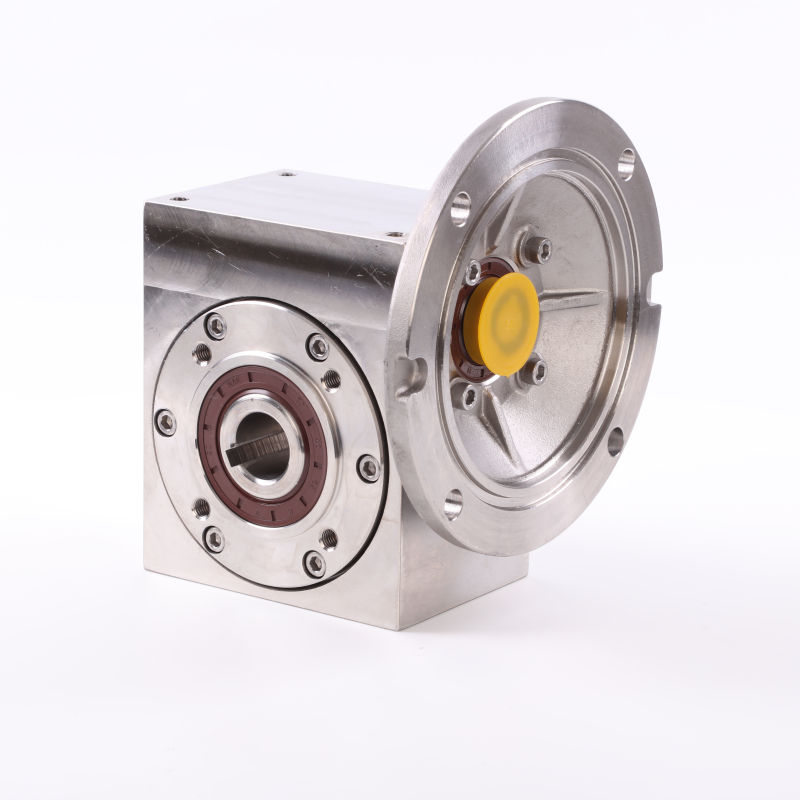
You've identified a need for a stainless steel worm gearbox in a high-humidity bottling plant. Now, the datasheets are filled with numbers. The key is to focus on the specs that directly impact performance and lifespan. The gear ratio is fundamental—it defines the speed reduction and torque multiplication. A higher ratio means more torque but slower output speed. Next, evaluate the rated output torque and overhung load capacity. Exceeding these values will lead to premature wear and failure. Thermal capacity is often overlooked; a gearbox that overheats loses efficiency and can seize. For demanding, continuous operations, selecting a unit with a generous thermal margin is crucial. This is where expertise matters. Raydafon Technology Group Co.,Limited engineers its stainless steel worm gearboxes with optimized heat dissipation and robust bearing systems, ensuring they deliver consistent performance even under strenuous, sustained loads, directly answering the core question of How to select the right stainless steel worm gearbox for your application?.
| Specification | What It Means | Impact on Selection |
|---|---|---|
| Gear Ratio (i) | Ratio of input shaft revolutions to output shaft revolutions. | Determines output speed and torque. e.g., i=30:1 reduces speed 30x, increases torque. |
| Rated Output Torque (T2) | The maximum continuous torque the output shaft can deliver. | Must exceed your application's requirement with a safety factor (e.g., 1.5x). |
| Mechanical Efficiency (η) | Percentage of input power delivered as output power. | Worm gearboxes have lower efficiency (often 50-90%). Affects motor sizing and heat generation. |
| Overhung Load (OHL) & Thrust Load | Radial and axial forces the output shaft can withstand. | Critical if using pulleys, sprockets, or gears on the output shaft. |
A procurement manager sourced a "stainless steel" gearbox for a wastewater treatment scraper. Six months later, pitting and corrosion appeared on the housing, threatening a plant shutdown. The issue? While the housing was stainless, internal components like the worm shaft were not, and the sealing was inadequate. True suitability goes beyond the surface. For full corrosion resistance, insist on gearboxes where all wetted parts—housing, worm wheel, shaft—are made from grade 304 or 316 stainless steel. The sealing system is equally vital; look for high-quality lip seals or mechanical seals that achieve IP66/IP67 ratings or higher. Precision machining and proper lubrication (often food-grade grease for sensitive industries) ensure smooth operation and long service intervals. Partnering with a specialist manufacturer like Raydafon Technology Group Co.,Limited guarantees this holistic approach. Their commitment to full stainless steel construction and superior sealing directly solves the durability problems procurement professionals face, delivering a product that stands up to the application's promise.
| Component | Material & Construction Focus | Benefit for Your Application |
|---|---|---|
| Housing & Covers | AISI 304 or 316L Stainless Steel, precision machined. | Maximum corrosion resistance, structural integrity, and cleanability. |
| Worm & Worm Wheel | Hardened stainless steel worm matched with bronze or stainless wheel. | Optimal wear resistance, low friction, and long operational life. |
| Shafts | Stainless steel, ground and polished, with keyways or hollow bore options. | Corrosion-resistant power transmission with precise connection fit. |
| Seals & Gaskets | FKM (Viton) or NBR seals, labyrinth designs for high IP ratings. | Prevents ingress of water, dust, and chemicals, protecting internal gears. |
The final, and perhaps most critical, step isn't about the gearbox itself, but about who supplies it. You need more than a catalog; you need a partner. Can they provide detailed CAD models for integration? Are their technical datasheets comprehensive and clear? Do they offer custom modifications like special shaft lengths, mounting flanges, or specific paint finishes? Reliable after-sales support, including warranty and access to spare parts, is non-negotiable for minimizing downtime. A true partner invests in engineering support to help you validate your selection. Raydafon Technology Group Co.,Limited embodies this partnership model. With deep expertise in stainless steel power transmission, they assist buyers in navigating the selection process, ensuring the gearbox not only fits the specs but excels in the real-world application, providing peace of mind and a reliable supply chain.
Q: What is the main advantage of a stainless steel worm gearbox over a standard cast iron one?
A: The primary advantage is superior corrosion resistance. Stainless steel gearboxes are essential for applications exposed to moisture, chemicals, frequent washdowns (food, beverage, pharmaceutical), or outdoor environments. They prevent rust, contamination, and premature failure, ensuring hygiene and long service life even in harsh conditions.
Q: How do I determine the correct size and ratio for my application?
A: You need three key pieces of information: 1) The required output torque (including a safety factor), 2) The input speed from your motor (RPM), and 3) The desired output speed (RPM). The ratio is Input RPM / Output RPM. The size (frame) is determined by the torque requirement and duty cycle. Reputable suppliers like Raydafon Technology Group Co.,Limited provide selection software or expert engineering support to help you accurately calculate these values and choose the optimal model.
Selecting the perfect stainless steel worm gearbox is a detailed process, but it's fundamental to your machine's reliability and efficiency. We hope this guide has provided a clear path forward. Have a specific application scenario or a challenging set of parameters? We'd love to hear about it and discuss potential solutions.
For over two decades, Raydafon Technology Group Co., Limited has been a trusted partner for engineers and procurement specialists worldwide, specializing in high-performance stainless steel gearboxes and power transmission solutions. Our focus is on delivering durability, precision, and expert support for demanding industrial applications. For detailed quotations or technical consultations, please contact our team at [email protected].
Smith, J., & Chen, L. (2021). Corrosion Behavior of AISI 316L Stainless Steel in Simulated Food Processing Environments. Journal of Materials Engineering and Performance, 30(5), 3456-3465.
Kumar, R., et al. (2020). Thermal Analysis and Efficiency Optimization of Worm Gear Reducers Under Continuous Duty Cycles. Mechanism and Machine Theory, 152, 103942.
Zhang, H., & Wang, P. (2019). The Influence of Surface Finish and Lubrication on the Wear Life of Stainless Steel Worm Gears. Wear, 436-437, 203021.
European Hygienic Engineering & Design Group (EHEDG). (2022). Hygienic Design Criteria for Gearboxes and Drives in the Food Industry. Document 44.
Patel, A., & Jackson, S. (2018). Selection Methodology for Corrosion-Resistant Gearboxes in Offshore and Marine Applications. Offshore Mechanics and Arctic Engineering Conference, OMAE2018-78124.
Li, Y., et al. (2020). Finite Element Analysis of Stress Distribution in Stainless Steel Gearbox Housings. Engineering Failure Analysis, 118, 104882.
International Organization for Standardization (ISO). (2017). ISO 14635-1: Gears - FZG test procedures - Part 1: FZG test method A/8,3/90 for relative scuffing load-carrying capacity of oils.
Garcia, M., et al. (2021). Seal Performance and IP Rating Validation for Washdown-Industrial Equipment. Tribology International, 163, 107187.
Davies, A. (2019). Practical Guide to Selecting and Applying Worm Gear Speed Reducers. Power Transmission Engineering, 13(4), 28-33.
Fischer, U., & Schulze, T. (2022). Lifetime Prediction Models for Worm Gearboxes Based on Load Spectra and Material Data. Forschung im Ingenieurwesen, 86(1), 45-58.